Firebird Database Replication
Reliable, Near-Real-Time Synchronization for Mission-Critical Systems
Holger Klemt, August 2026
Modern applications increasingly require databases to remain available across multiple locations, servers, and environments. Whether the goal is high availability, migration from a desktop application to a web-based system, distributed databases, or continuous synchronization between data centers, reliable database replication is a critical component.
Our Firebird replication solution has been developed for precisely these scenarios. It combines transaction-safe replication, near-real-time synchronization, one-to-many replication, and support for large Firebird databases — while allowing replication to be introduced into an existing production environment without taking the database offline.
Designed for Firebird
The replication framework supports Firebird 2.5 and newer versions, including Firebird 4, Firebird 5 and current Firebird 6 databases.
A key advantage is that replication is implemented directly at the database level using active triggers and a transaction log. Changes made to the source database are recorded as transactions and can subsequently be transferred to one or more target databases.
This architecture ensures that changes are not lost simply because the network connection or replication process is temporarily unavailable.
Replication without production downtime
One of the most important requirements in a migration or high-availability project is the ability to activate replication without interrupting the running application.
Our replication process is designed for exactly this purpose.
Once replication is initialized, the required triggers begin recording INSERT, UPDATE and DELETE operations in a dedicated transaction log. The production database continues to operate normally.
The initial synchronization can then be performed by creating a backup of the master database and restoring it on the target server. This process can also be performed without taking the production database offline.
After the target database has been initialized, the replication process transfers all transactions that occurred while the backup was being created and subsequently continues with new transactions.
Transaction-safe replication
Reliability is at the heart of the architecture.
Imagine that the master database has accumulated 100 transactions waiting to be replicated. If the network connection fails after only part of the data has been transferred, the remaining transactions are not lost.
They remain in the transaction log and are transferred during the next replication operation.
The replication process therefore does not depend on a permanently available network connection. A target server can even be unavailable for days or weeks while the master database continues to collect the transactions required for synchronization.
When the target becomes available again, replication can continue from where it stopped.
One-to-many replication
The architecture also supports one-to-many replication.
A single master database can replicate its data to multiple target servers. Each target is tracked independently.
For example:
Master Server → Slave 1
Master Server → Slave 2
Master Server → Slave 3
If Slave 2 is temporarily offline, replication to Slave 1 and Slave 3 can continue normally. The transactions required for Slave 2 remain available on the master until that target reconnects.
This makes the architecture suitable for distributed systems where individual locations may have unreliable network connections or temporarily unavailable servers.
Multi-master replication
Depending on the database structure, the technology can also support multi-master replication.
In this configuration, several servers can act as master databases and exchange changes between one another.
However, multi-master environments require careful consideration of the database design, particularly primary-key generation. For example, automatically generated keys must be designed so that records created independently on different master servers cannot produce conflicts.
Where necessary, database metadata and application logic can be adapted to support this architecture.
Near-real-time synchronization
The replication process is designed for near-real-time operation.
In a typical environment, transactions are transferred continuously through a push/pull process. The actual latency depends on server performance, transaction volume and network conditions.
In one large distributed deployment, changes were typically visible at remote locations in less than 10 seconds. Even under periods of very high system load, latency generally remained within approximately one minute.
Locations with slower or unreliable Internet connections could continue operating locally. Once connectivity was restored, accumulated transactions were synchronized automatically.
Proven with large and distributed Firebird installations
The technology has been used in demanding real-world environments involving large databases and geographically distributed systems.
One particularly extensive project involved:
- 9 central servers
- 6 different data centers and cities
- Approximately 225 Firebird databases at individual locations
- Approximately 500 GB in the largest central database
- Around 2 billion records in the largest database
- Approximately 5–6 million INSERT, UPDATE and DELETE operations per day
- Near-real-time synchronization between the central systems and remote locations
The individual remote databases contained subsets of the central data and synchronized local changes back to the central infrastructure.
Despite unreliable network connections at some locations, the replication architecture ensured that transactions remained available until they could be transferred successfully.
Handling very large databases and BLOB data
Large Firebird databases can contain substantial amounts of BLOB data, particularly in applications such as healthcare, document management, imaging and archive systems.
In one implementation, the overall database environment reached approximately 7 TB, including transaction logs and annual BLOB databases.
For very large datasets, separating historical data into dedicated databases can provide significant advantages.
For example, annual transaction or BLOB databases can be closed and made read-only at the end of a financial year. They remain accessible via the main database, but no longer increase the size of the active production database.
This approach can significantly simplify and accelerate future backup and restore operations.
No single point of failure in the replication process
A temporary failure of a target server or network connection does not stop the master database from recording changes.
This is particularly important for distributed installations.
A remote server may be restarted, disconnected, or unavailable for an extended period. Once it becomes available again, the replication process can continue using the transactions that accumulated while it was offline.
The result is a replication architecture designed around reliable, post-event synchronization without data loss, which does not require all servers and network connections to be permanently available.
Database metadata plays a crucial role
Reliable replication starts with a suitable database design.
Ideally, every table that needs to be replicated should have a primary key or at least a suitable unique index.
Primary keys should also be reasonably compact. Extremely complex primary keys spanning a large number of columns can make replication and application development unnecessarily complicated.
Tables without primary keys may require an alternative identification mechanism. Depending on the database structure, a different technology based on Firebird's RDB$DB_KEY can be considered.
For complex environments, the database metadata can be analyzed before implementation to determine the most appropriate replication strategy.
Continuous replication with minimal maintenance
Once implemented, the replication system is designed to operate largely in the background.
In many installations, no regular manual maintenance is required.
Nevertheless, database administrators may occasionally perform extensive metadata changes or structural modifications that require replication to be reinitialized or adjusted.
For such situations, remote technical assistance can be provided through a prepaid support and hotline system. This allows administrators to request assistance when required rather than maintaining a permanent support contract solely for occasional replication operations.
Implementation and migration
Every replication project is different. Database size alone is not sufficient to determine the implementation effort.
Before a project begins, we therefore recommend analyzing:
- The database metadata
- Primary keys and indexes
- Database statistics
- Number and size of databases
- Transaction volume
- BLOB usage
- Network topology
- Number of replication targets
- Required replication direction
- Expected availability and recovery requirements
A metadata-only backup is often sufficient for the initial technical assessment. This allows the database structure to be reviewed without providing access to sensitive customer data.
Implementation and training can be carried out entirely remotely – even for customers in distant time zones.
Source code and customization
The replication framework can be delivered together with its source code, allowing customers to understand, adapt and integrate the solution into their own environment.
This is particularly valuable when replication forms part of a larger migration project, such as moving an existing desktop application to a web-based architecture while keeping the existing production system operational during the transition.
A practical foundation for system migration
Database replication is especially valuable when an organization needs to modernize an existing application without accepting prolonged downtime.
For example, a healthcare information system (HIS) and its associated image database may need to remain continuously available while the underlying application is migrated from a desktop architecture to a modern web application.
A transaction-based replication layer can provide a bridge between the existing and new environments, allowing both systems to operate while data is continuously synchronized.
This can substantially reduce migration risks and enable a controlled transition rather than a disruptive "big bang" migration.
A solution built on real-world experience
The architecture described here is not limited to laboratory scenarios. It has been used for more than a decade in demanding production environments with geographically distributed Firebird databases, large transaction volumes, unreliable network connections and substantial amounts of data.
The combination of transaction logging, trigger-based change tracking, push/pull replication and independent target tracking provides a robust foundation for high-availability and distributed Firebird environments.
For organizations planning a Firebird migration, high-availability project, distributed database architecture or near-real-time synchronization solution, the first step is a technical review of the existing database environment.
With the database metadata and current database statistics available, a realistic implementation plan, replication architecture and project-specific quotation can be prepared.
Sales tax/VAT
The sales tax applicable for your country of residence is calculated once you have entered your full details for the invoice.
Important for members of EU countries: You must enter your EU VAT ID in the correct field when placing your order. Otherwise you will be charged VAT at the current rate applicable for your country.
Risiken einer Business Software als Cloud Lösung
Firebird White Paper
Holger Klemt, Januar 2026
Was tun, wenn der Porsche nicht mehr anspringt oder Ihre Cloud ERP auch nicht mehr einsetzbar ist?

Sicher haben einige Leser schon die aktuellen Artikel über unzufriedene Porschekunden in Russland gelesen, deren Fahrzeuge nicht mehr starten, weil eine global implementierte Diebstahlsicherung im Fahrzeug wegen fehlendem Cloudzugriff das Fahrzeug vorsichtshalber dauerhaft blockiert und die Kraftstoffzufuhr so abschaltet, dass man das auch nicht mit simplen Tricks umgehen kann, auch wenn da wohl schon einige Anbieter Workarounds angeboten haben. Porsche hat aus guten Gründen jeglichen Support für Russland sanktioniert, man sollte also von der Seite keine Lösung erwarten.
Was hat diese Geschichte mit einer Cloud ERP Lösung zu tun?
Nun denn, das werden sicherlich diverse Kunden früher oder später auch zeitnah merken.
Die Idee zu diesem White Paper wurde ausgelöst durch die Entscheidung eines mittelständischen Unternehmens in Deutschland, welches an mehreren Standorten bisher auf einer selbstgeschriebenen Delphi/Firebird Anwendung gesetzt hat und diese im Laufe der letzten 30 Jahre immer mehr erweitert und dabei Prozesse anforderungsspezifisch umgesetzt hat. Da war nicht alles perfekt, aber gerade im Bereich der Logistik wurden immer wieder wechselnde Standards so realisiert, dass es genau den Anforderungen entsprach.
Vom Konzept zur wirklich funktionierenden Web-App in 30 Minuten
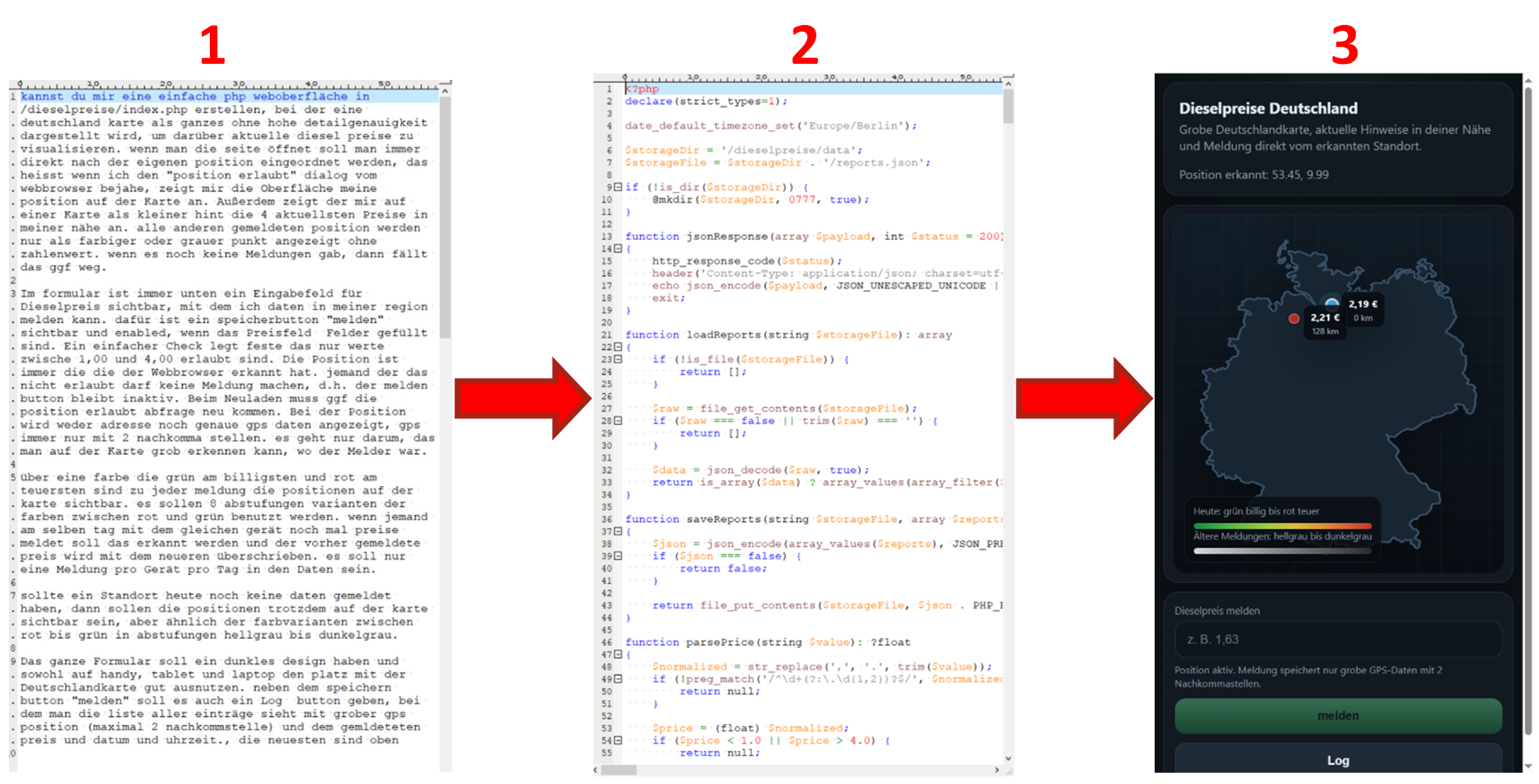
Wie schnell entsteht heute eine funktionale Webapplikation? In unserer Demo zeigen wir euch die Basics, die wir in unserem Workshop vertiefen.
Der Ansatz: Ein Gedankenmodell statt Code
Für unsere Beispiel-Anwendung „Dieselpreise Deutschland“ haben wir lediglich eine einfache Beschreibung auf Deutsch verfasst. Der Fokus liegt dabei auf dem logischen Modell: Welche Prozesse sind relevant? Wie sehen die Ein- und Ausgabemasken aus? Man beschreibt das Projekt so, wie man es einem Entwicklerteam rudimentär erklären würde – ohne sich in Details zu verlieren. Den ursprünglichen Entwurf (inklusive kleinerer Tippfehler) findet ihr in Bild 1.
Die Umsetzung: KI-gestützte Bereitstellung
Mit dieser Textdatei bewaffnet, starten wir eine Konsolensitzung auf einem Linux-Server. Ob Konfiguration von SSL, Apache oder PHP – all diese Schritte lassen sich heute effizient mit KI-Unterstützung erledigen. Im Workshop zeigen wir euch den kompletten Weg vom „nackten“ Server bis zur laufenden Applikation.
Das beeindruckende Ergebnis: Die KI generierte nicht nur den PHP-Code (siehe Bild 2), sondern legte die Dateien direkt im richtigen Verzeichnis ab und setzte alle erforderlichen Berechtigungen.
Das Ergebnis: Funktional in Rekordzeit
Keine 30 Minuten später – inklusive Textentwurf und drei kurzen Korrekturschleifen für das Design der Deutschlandkarte – war die Anwendung im Browser startklar. Die weiteren Zeilen der PHP-Datei erspare ich euch, weil wir dann nämlich im nächsten Schritt direkt die wirklich schon gut funktionale PHP-Datei im Webbrowser öffnen und sehen dort dann das, was wir in Bild 3 sehen.
Das Entscheidende dabei: Änderungen wurden nicht auf Code-Ebene vorgenommen, sondern durch einfache deutsche Anweisungen an die KI.
Probiert es direkt aus: https://ibe901.ibexpert.com/dieselpreise/
Tragt aktuelle Dieselpreise in das System ein und seht selbst, wie die Daten live verarbeitet werden. Wir alle können die dann sehen und uns gruseln, dass es woanders noch schlimmer ist ....
Wenn ihr dabei seid, steht euch also auch offen, auf Basis genauso einer beschreibenden Textdatei mit einer wirklich bezahlbaren ChatGPT Lizenz (aktuell ca. 200 USD pro Monat) eine Webapplikation ganz nach euren Vorgaben umzusetzen.
Was euch im Workshop erwartet:
Wir gehen weit über einfache Textdateien hinaus:
Datenbank-Power: Erfahrt, wie ihr Firebird-Datenbanken anbindet, um komplexe Logiken dort zu verarbeiten, wo sie hingehören.
Modularität: Wir zeigen euch, wie man Anwendungen sinnvoll in Formulare unterteilt, um Folgefehler zu minimieren und die Übersicht zu behalten.
Hardware-Integration: Seht, wie schnell Funktionen wie die QR-Code-Erkennung via Handykamera heute realisierbar sind.
Komplexe Datenverarbeitungsschritte setzen wir aber weiterhin in der Datenbank selbst um, weil das Regelwerk dort oft weit über das hinausgeht, was man mal eben in einem Text auf einer DIN A4 Seite beschreiben kann.
Mit einer gängigen ChatGPT-Lizenz und dem richtigen Know-how setzt ihr Webapplikationen künftig exakt nach euren Vorstellungen um.
Detaillierter Workshop Inhalt: Workshop IBExpert, Firebird, KI und PHP-Webapplikationen
Preis pro Person: 899 EUR netto zzgl. Mehrwertsteuer
Kaffee, Wasser + Mittagessen inklusive
Anmeldung: register@ibexpert.net
Termin oder Ort passen nicht? Wir bieten den Workshop auch individuell als Firmen- oder Remote-Workshop an.
Anor Hotel & Conference Center Frankfurt Airport
An der Brücke 8-10
64546 Mörfelden-Walldorf
www.anorhotels.de
Payment options
PayPro Global offers a wide range of payment options and currencies: https://payproglobal.com/payment-methods/
Hotline
Recently we received an enquiry from a customer and it quickly became clear that they were an end user and had issues with the performance of their server, specifically their wish was that they would like it to take less than half an hour to call up an invoice!
During this conversation however, the customer stated that they a), had reservations about confiding in our hotline (due to various previous "support" experiences with a call center) and b), could not conduct the conversation themselves because their own competencies lie in the company’s core business and not dealing with hard- or software issues.
Our hotline connects you directly to a qualified and experienced technician, via telephone or GoToMeeting; you will not end up at a call center spending hours on hold, only to receive a standard answer, read from the operator’s screen.
As soon as a support appointment has been confirmed by us, we are quickly able to detect the issue and address it immediately. The support call can be with your in-house IT Manager or external IT support company.
Rest assured: you are in good hands with our IBExpert hotline and we will be able help you.
Read more: IBExpert & Firebird Prepaid Hotline